
History of Kazakhstan
Important milestones in the history of Kazakhstan
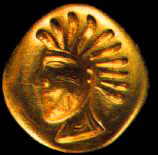 Kazakhstan has a long and fascinating history, going back thousands of years. Some remnants are still visible today such as Great Silk Road monuments, petroglyphs and sometimes even mysterious archaeological sites. The Amazons might have originated from Kazakhstan, the first steppe nomads are supposed to have emerged from here and it is very likely that Genghis Khan was buried in Eastern Kazakhstan. In recent times more and more details about Kazakh history and culture have been re-discovered, making the country also more and more interesting for domestic and international culture seekers.
The territory of Kazakhstan came to be mastered by man nearly a million years ago. As early as the age of the Lower Paleolithic, ancient man settled down on these Karatau lands fit for normal life, rich with game and wild fruit. It is here that they have found ancient settlements from the Stone Age. By and by, in the centuries of the Middle and Upper Paleolithic, man came to master Central and Eastern Kazakhstan and the Mangyshlak area.
As has been shown by excavations of the Neolithic settlement Botay in Northern Kazakhstan, Kazakhstan constitutes a region of horse domestication (breeding) and that of the formation of nomadic civilizations. Archeologists have revealed dwellings and numerous hand-made articles of stone and ivory which present the ancient history and archeology of Kazakhstan in the Stone age in an altogether new way.
As early as the Bronze Age, some four millennia ago, the territory of Kazakhstan was inhabited by tribes of the so-called Andron and Begazy-Dandybay culture. They were engaged in farming and cattle-breeding, and were fine warriors who handled combat chariots marvelously. To this day we can see images of chariots drawn on rocks where ancient people would arrange their tribal temples and sanctuaries with the firmament as their natural cover. On the surfaces of black cliffs burnt with the sun people would chisel out scenes of dances, images of sun-headed deities, mighty camels and bulls as impersonations of ancient gods.
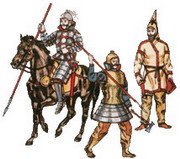 Burial mounds of noble warriors scattered all throughout Kazakh steppes are known for the magnificent size both of the mounds and burial vaults proper. Particularly famous are such necropolis in the steppes of Sary-Arka and Tagiskent in the Trans-Aral area. People of that epoch were not only fine warriors, shepherds and farmers but also skilled metallurgists. They would take bronze and manufacture axes, knives, daggers and various decorations thereof.
It was they who initiated the development of copper which is being practiced to this day - they are the Zhezkazgan and Sayak copper mines of today. Ancient people lived in large settlements and ancient towns surrounded with walls and towers.
These towns were inhabited by warriors and craftsmen, priests and farmers. These tribes lived on the territory of Kazakhstan for about a thousand years - from the 17th century B.C. to 9th-8th centuries A.D.
Later on they were ousted by the Saks. Such was the name given to this tribe by ancient Persians. The Chinese called them "se" whereas Greeks chose to call them Scythians. They were essentially nomads, semi-nomads and farmers. Yet, first and foremost, they were excellent horsemen. In fact, Saks were the first ever horsemen in the world to master arrow-shooting at full speed.
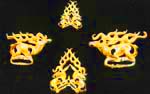
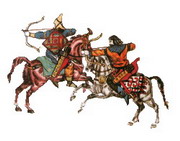 In the 5th-2nd centuries B.C., the Saks set up their first state with its center in the Zhetysu (Semirechje) in South-Eastern Kazakhstan. The kings of the Saks were at the same time high priests. Saks had a written language and a mythology of their own; they were known for their well developed art of world standard labeled in research papers as "animal-styled art". Respective subjects were represented by predators and herbivorous animals and the struggle there between. Sheer masterpieces made of gold and bronze serve as worthy exhibits in the best museums of the world. The linguistic situation was just as complicated. As is traditionally believed, in the course of the first millennium B.C., the population of Kazakhstan was mostly represented by native speakers of Indo-European and Indo-Iranian languages. However, of late, they are inclined to think that the tribes of the Bronze Age, particularly those of the Saks, included tribes that spoke proto-Turkic languages.
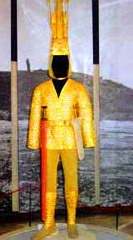 In the Issyk burial mound which harbored the world-famous "Golden Man" they have found a silver bowl whose bottom bore an inscription consisting 26 characters. They have failed to read it to this day. Some think that the inscription is made in one of the Iranian languages, others insist on its proto-Turkic origin. In any case, this must be the very period that highlighted the formation of the state of mind and the language of medieval and modern Kazakhs, their physiological stereotypes, in fact, of many an element of their culture, everyday life and folk rites.
 The middle of the first millennium A.D. is a fairly important stage in the history of all Turks in general and Kazakhs in particular. The period is marked with manifest changes in ethnic media: predominant now become Turkic tribes which chose the Altai as their natural center. Written sources of the 6th century register the term "Tyurk" which is pronounced as "Tutszyue" by the Chinese and as "Turk" by the Sogdians.
Archeological studies of Turkic monuments make it possible to somehow compare "these" Turks with certain Turkic tribal associations. In the Sayano-Altai region they have identified certain archeological cultures which might well be likened to early Kyrgyz, early Kypchaks or early Oguzes. In the course of not infrequent internecine wars, tribal discord, and struggles for power and pasture, a part of the Turkic tribes which inhabited the steppes and valleys of Kazakhstan moved southwards - to Central Asia (say, Tyurgeshes, Karluks, Kypchaks, Uzbeks, Oguz, and Turkmens-Seldzhuks), to Asia Minor, to the Caucasus (Turkmen and Seldzhuks), and to Eastern Europe (Kangars and Pechenegs, Kypchaks-and-Polovtsians, Torks-and-Oguz, black Klobuks and Karakalpakians).
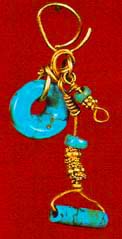 Starting from the 4th century up to the beginning of the 13th century, the territory of Kazakhstan was the seat of West-Turkic, Tyurgesh, Karluk Kaganates, of the state made by the Oguz, Karakhanides, Kimeks and Kypchaks. All of them successively replaced one another right up to the Mongol invasion. After the invasion, i.e. in the beginning of the 13th century, uluses of the Mongol Empire of Zhuchi-Khan and Zhagatai were formed, which later gave birth to Ak-Orda, Mongolistan and finally to the Kazakh Khanate.
Essentially all these states were mixed economies. Tribes of cattle-breeders had farming tribes as their neighbors, and steppes and cities supplemented each other. Such cities as Taraz, Otrar, Ispijab, and Talkhir were set up right in the middle of the Great Silk Road, which served as a reliable link joining antiquity and the Middle Ages, the West and the East: Japan, Korea and China with Central Asia, Iran, the State of the Seldzhuks, Rus, Byzantium, France and Italy.
 It is through the Great Silk Road that dancing arts, painting, architecture and music made their way from one people to another. Incidentally, it was the way along which various religions advanced: Manichaeism and Buddhism, Christianity and Islam, with the latter becoming predominant (starting from the 8th century) and subsequently the solitary faith of the Kazakhs. In the late 14th-early 15th century, on the banks of the Syrdaria River in the city of Turkestan, they erected a religious sacred place worshipped by all Turkic-speaking nations - the complex of Khodja Akhmed Yasavi.
The nation that inhabited the territory of Kazakhstan would avidly absorb and assimilate all the ideas and achievements of various civilizations, making - in its turn - its own contribution to the treasury of world culture, be it economy or handicraft or music: among numerous accomplishments one may name the mobile dwelling "yurta", saddles and stirrups for horses, combat arts on horse-back, carpet ornaments and silver jewelry, sweet melodies and music reminding one of the impetuous gallop of steppe horses...
All these factors have determined the integrity and continuity of the ancient and medieval history of Kazakhstan.